What does 'plant-based cleaning' actually mean?
- by Josie Harfield
Walk down any supermarket cleaning aisle and every second bottle claims to be plant-based, plant-powered, botanical, natural or made with something that grew in the ground. Most of it means something. Some of it means very little. Almost none of it is defined by law.
Here's what plant-based cleaning actually is, what it isn't, and how to work out whether a product's claim is worth anything.
The short definition
A plant-based cleaner is one where the active cleaning ingredients — the surfactants, the acids that dissolve limescale, the compounds that break down grease — come from plants rather than petroleum.
Petroleum-derived ingredients aren't inherently dangerous. They're the default because they're cheap. But they're a finite resource, their production is carbon-heavy, and once they enter a household waste stream they don't biodegrade cleanly.
Plant-derived alternatives do the same job. They come from corn, coconut, palm (ideally sustainably sourced or replaced), citrus, sugar cane and a handful of others. They biodegrade in water treatment. And they don't require pumping oil out of the ground to make bathroom cleaner.
What plant-based DOESN'T mean
Three things it isn't:
• It isn't a legal claim. Nobody regulates the phrase. A product could contain 5% plant-derived ingredients and 95% conventional and still legally call itself plant-based on the front label.
• It isn't the same as "natural" or "organic". Natural has no cleaning industry definition at all. Organic means the ingredients meet farming certifications — which is different, and doesn't apply to most cleaning chemistry anyway.
• It isn't automatically safer for skin. Some plant-derived ingredients are irritants. Essential oils in particular can trigger sensitivities. Look for dermatologically tested claims separately.
What it does reliably mean is that a specific proportion of the formula's active ingredients came from renewable, biodegradable sources. Which is better than the alternative, but only if the proportion is meaningful.

What to look for on a label
Six things worth checking on any cleaning product claiming to be plant-based:
1. The percentage
The best brands tell you what fraction of the formula is plant-derived. If it's not on the label or the product page, assume it's low. Meaningful plant-based products declare 90%+ plant-derived actives.
2. The full ingredient list (INCI)
Legally, every ingredient over 1% must be named. Ingredients like sodium coco sulfate, cocamidopropyl betaine, decyl glucoside and lauryl glucoside are plant-derived (coconut, sugar). Sodium lauryl sulfate (SLS) and sodium laureth sulfate (SLES) can be plant-derived or petroleum-derived; the label rarely tells you which.
3. Free-from claims
A brand serious about plant-based will pair the claim with what they've excluded: sulphates, parabens, phosphates, chlorine bleach, ammonia, synthetic dyes and synthetic musks. If a plant-based product still contains those, the claim is doing marketing work, not chemistry work.
4. Certifications
Independent certifications are harder to fake. Look for B Corp (whole-business audit), Cruelty Free International (Leaping Bunny — no animal testing at any supply chain stage), and ECOCERT or COSMOS (formulation-level standards).
5. Biodegradability
A serious plant-based product will state biodegradability — usually 90%+ within 28 days per OECD 301 tests. Petroleum-derived surfactants can biodegrade too, but plant-derived versions typically do so faster and more completely.
6. Fragrance
Fragrance is where many otherwise-good products fall down. "Fragrance" or "parfum" on an INCI list can hide dozens of undeclared compounds. Brands that use IFRA-compliant natural essential oils will usually say so.
The bigger picture
Plant-based cleaning isn't a silver bullet. It's a lower-impact way of doing something we all do anyway. The bigger environmental levers are packaging (single-use plastic vs refillable), transport (concentrates vs pre-mixed bottles) and formulation efficiency (do you need 500ml of cleaner or 50ml of concentrate).
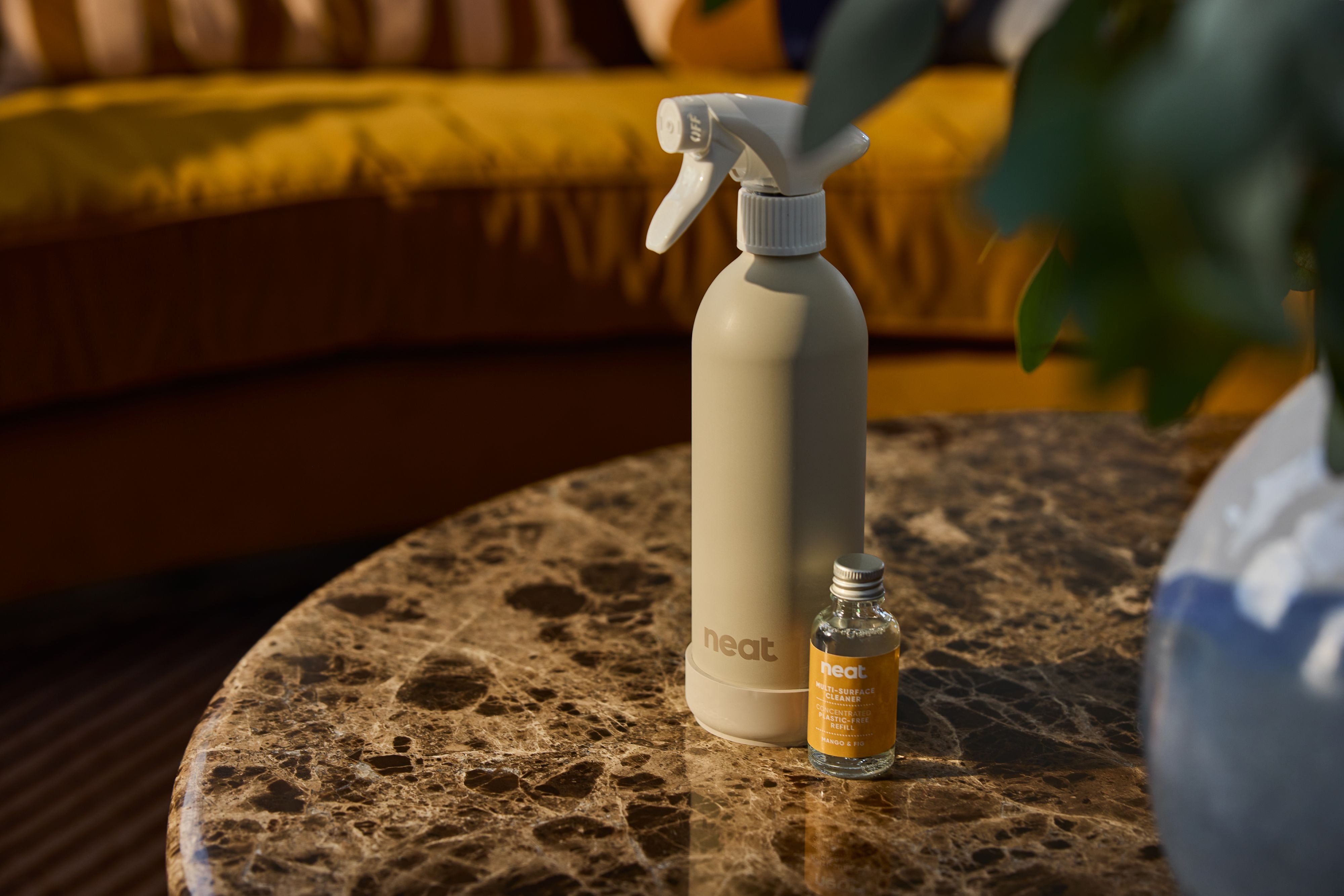
The neat. approach: plant-based active ingredients, concentrated refills, refillable aluminium bottles, and full ingredient transparency on every product page. It's not the only way to do it. It's a way that adds up.
Frequently asked questions
Is plant-based cleaning as effective as conventional?
For household cleaning, yes. Plant-derived surfactants are as effective at breaking down dirt and grease as petroleum-derived ones. Antibacterial plant-based formulas are tested to the same EN standards as conventional ones — a 99.9% bacteria kill claim means the same thing regardless of the source of the active ingredients.
Are plant-based cleaners safer to have around children and pets?
Generally yes, but not automatically. Some plant-derived essential oils are toxic to cats (tea tree, citrus) even in small quantities. Read the safety guidance on each product; don't assume plant-based means safe by default.
Do plant-based cleaners work in hard water?
Yes. Water hardness affects how much cleaner you need, not whether it works. In very hard water areas, you may find you use slightly more product per clean regardless of whether it's plant-based or conventional.
Is 'plant-based' the same as 'vegan'?
Similar but not identical. Vegan means no animal-derived ingredients (like beeswax or lanolin) and no animal testing. Plant-based refers specifically to the source of active cleaning ingredients. Most plant-based cleaning brands are also vegan; check both claims individually if it matters to you.
How can I check the plant-based claim on a specific product?
Look for three things: a stated plant-derived percentage, a full INCI ingredient list, and an independent certification (B Corp, ECOCERT, Leaping Bunny). If a product has all three, the claim is solid. If it has none, the claim is marketing.