How to remove limescale from taps and shower heads
- by Josie Harfield
Limescale is the white, chalky build-up that clings to taps, shower heads, kettles and around plug holes in most of England and Wales. It's calcium carbonate, left behind when hard water evaporates. It doesn't damage anything, at first. But left alone, it clogs shower jets, dulls tap finishes, and takes twice as long to remove later.
Getting it off is straightforward chemistry. You need an acid — mild, food-safe, cheap — and time. Here's how to do it properly.
Understand what you're dealing with
Hard water in the UK is at its worst in the south-east, the Home Counties, London and East Anglia. Roughly 60% of UK households live in hard-water areas. If your kettle scales up fast, so will everything else in the bathroom.
Limescale is alkaline, so it dissolves in acid. The acids you want are:
• White vinegar (5% acetic acid). Cheap, food-safe, effective for light to moderate build-up.
• Citric acid powder (from lemons, technically). Stronger than vinegar, no smell, easy to dose. The best option for heavy build-up.
• Lemon juice. Fine for very light limescale on chrome. Not strong enough for anything serious.
What you don't want: commercial descalers with hydrochloric acid or sulphamic acid. They work, but they're harsh, they can damage chrome and stone finishes, and the fumes are unpleasant in a small bathroom.
Step 1 — Taps: the bag method
For most taps, the easiest way to soak the whole spout is to tie a small plastic bag of white vinegar around it. Half-fill a sandwich bag with white vinegar, hold it up so the spout sits fully submerged, and tie it around the tap with a rubber band or hair tie. Leave for 30 minutes to an hour for light build-up; up to four hours for heavy.
For citric acid: dissolve two tablespoons of citric acid powder in a mug of warm water, use the same bag method. Stronger and faster than vinegar.

Step 2 — Taps: the scrub
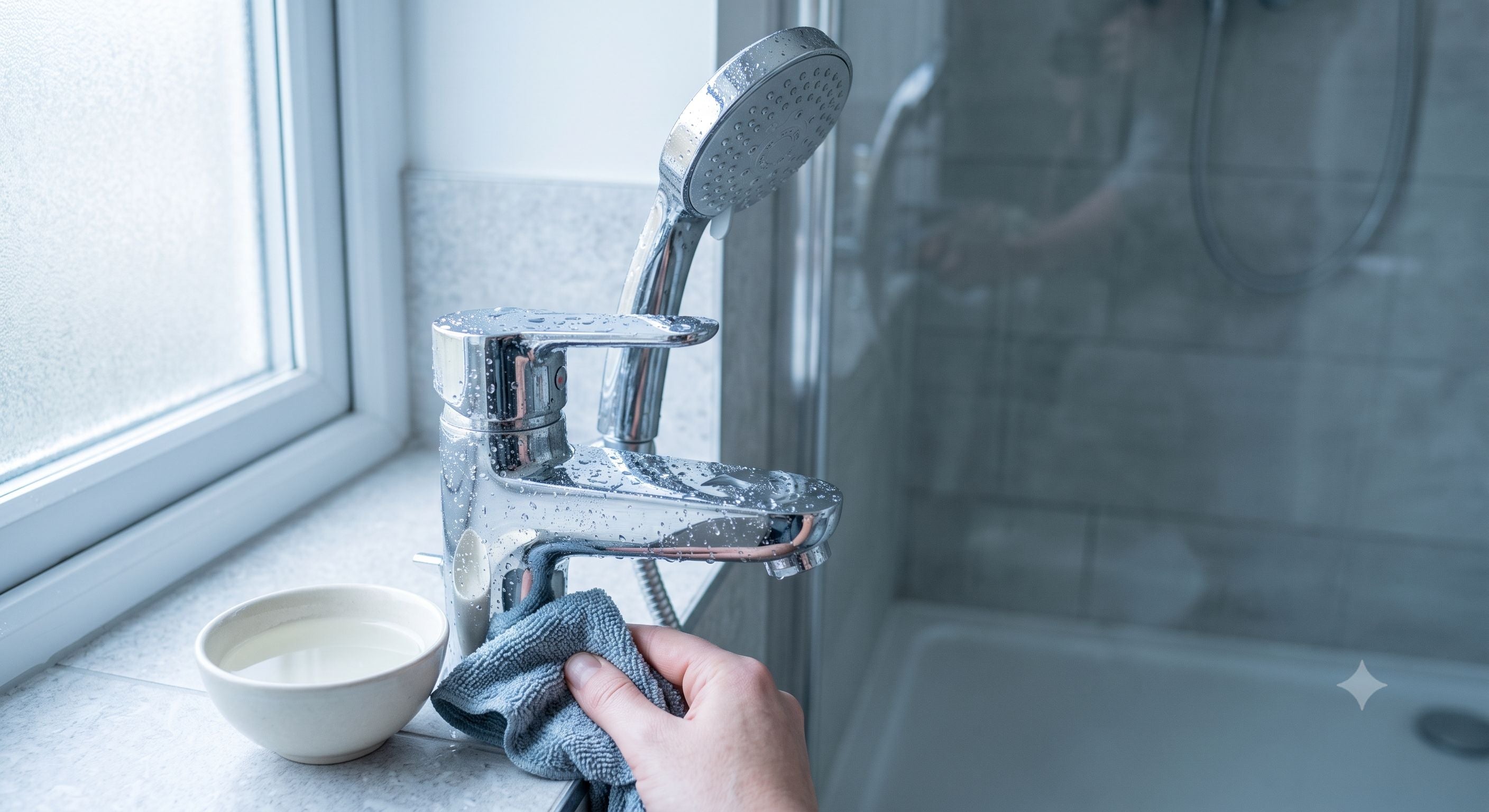
Untie the bag. Use an old toothbrush to scrub around the spout, the base of the tap and any grooves. The limescale should come away as a soft white paste. Rinse thoroughly with warm water — acid residue can etch chrome if left.
Follow with a plant-based bathroom cleaner (a NeatClean Daily Shower spray works well for the routine wipe-down afterwards) to remove any acid residue and leave the finish clean. Buff dry with a microfibre cloth to avoid water marks reforming.
Step 3 — Shower heads: the soak
Shower heads are the hardest to descale because the jets clog from the inside. If you can unscrew the head from the hose (most modern ones can), drop it into a bowl of warm vinegar or citric acid solution and leave for at least an hour. Overnight for heavy build-up.
If you can't remove the head, use the bag method — fill a sandwich bag with vinegar, tie it around the head so it's fully submerged, leave overnight.
After soaking, run the shower on hot for two minutes to flush loosened debris out of the jets. If some jets are still blocked, poke them clear with a straightened paper clip.
Step 4 — Prevention
Descaling is a maintenance task, not a one-off. In a hard-water area, once a month is realistic; every three months if your water is softer.
The best prevention is daily wiping. A quick spray-and-wipe after every shower stops limescale forming. Any plant-based bathroom spray works — this is what the Daily Shower spray was designed for.
Water softeners help significantly (whole-house systems reduce scale in every fixture), but they're a bigger investment. In the meantime, a soft cloth and a five-second wipe after each shower does most of the job for free.
What not to do
Don't use bleach on limescale. Bleach doesn't touch limescale — it's not an acid — and can react badly with any acidic descaler you use afterwards.
Don't use wire wool or metal scrapers on chrome. They scratch the finish, and scratches trap water and grow limescale faster.
Don't leave acid on chrome or stone longer than needed. Vinegar is mild; citric acid is stronger. Both will etch if left overnight on a polished chrome finish.
Frequently asked questions
Is white vinegar safe on all bathroom fittings?
Safe on chrome, glass, tile and porcelain. Avoid using it on natural stone (marble, travertine, unsealed granite) — acid can etch the surface. Avoid on brushed nickel or brass — it can dull the finish. Test in a small spot first if unsure.
How often should I descale in a hard water area?
Monthly for taps and shower heads if you're in a very hard water area (south-east England, parts of London, East Anglia). Every two to three months in moderately hard areas. Daily wiping between deep descales makes each descale much easier.
Can I use lemon juice instead of vinegar?
For very light build-up, yes. Lemon juice is about 5% citric acid — similar strength to vinegar but with a fresher smell. For heavy limescale, dissolved citric acid powder is much more effective per pound spent
Why does my shower head keep blocking even after descaling?
Two common causes: jets fully blocked from the inside (soak the whole head in citric acid solution overnight, not just spray the outside), or a build-up of grit from old pipework (usually needs a plumber to check the pipe supply).
Is limescale bad for me?
No — it's calcium carbonate, essentially chalk. Drinking hard water is fine; some studies suggest slight cardiovascular benefits from the mineral content. Limescale is a cosmetic and mechanical problem, not a health one.